
That mold test report you just got from the lab can feel like it’s written in a different language. Between the Latin names, the raw counts, and the scientific jargon, it’s easy to feel more confused than when you started.
At Mold Finders, we believe a report is only as good as your ability to understand it. As the 2026 Rookie Business of the Year for the Weston Chamber of Commerce, we’ve made it our mission to translate “Lab-Speak” into “Homeowner-Speak.”
Here is what you actually need to look for in your South Florida mold report.
1. The “Golden Rule”: Indoor vs. Outdoor Ratios
Mold is a natural part of the Florida ecosystem. It’s outside right now, and it’s likely on your clothes from your walk to the mailbox.
- The Goal: The concentrations of mold inside your home should be lower than the concentrations outside.
- The Red Flag: If a specific spore type is significantly higher inside than outside, or if a species appears inside that isn’t present outside at all, you likely have an “active source” (a colony) in your home.
2. Look for the “Marker Spores”
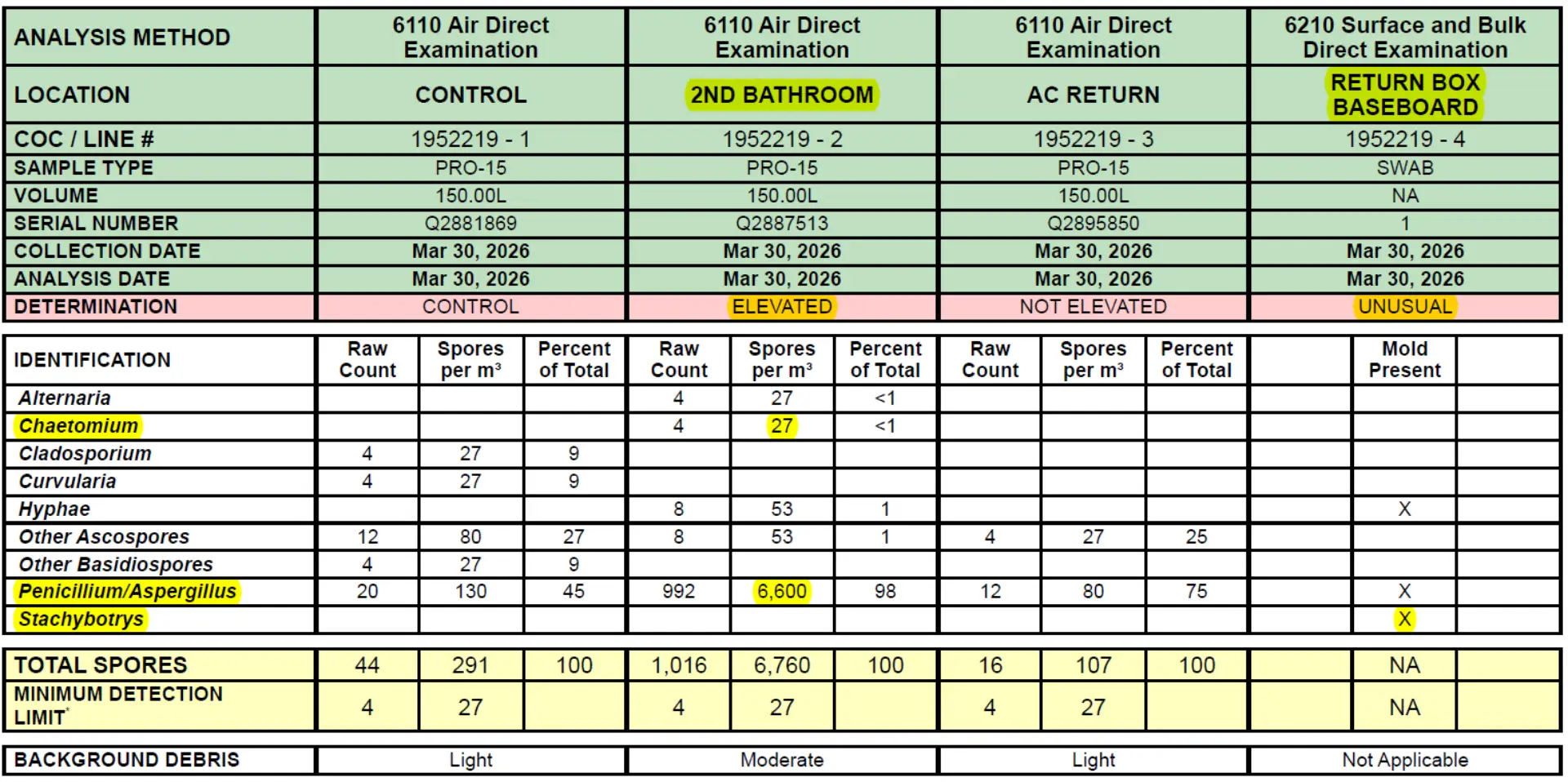
Not all molds are created equal. Some are “common” (like Cladosporium), but others are what we call Marker Spores. These are heavy, “sticky” spores that don’t travel easily through the air unless there is a major problem nearby.
- Stachybotrys (Black Mold): This is the one everyone fears. If it shows up on your report—even in small numbers—it’s a sign of a long-term moisture problem.
- Chaetomium: This usually indicates a current, active leak. It loves saturated drywall.
- Aspergillus/Penicillium: These are common, but in high numbers, they can impact your respiratory health and signify high humidity.
3. “Raw Count” vs. “Spores per Cubic Meter”
- Raw Count: This is the actual number of spores the technician found on the slide under the microscope.
- Concentration (Count/m³): This is the mathematical estimate of how many spores are in the air throughout the whole room.
- Why it matters: Don’t panic over a raw count of “10.” Look at the percentage of the total. If one type of mold makes up 90% of your indoor air, that’s where the trouble lies.
4. The Hidden Metric: Relative Humidity (RH)
A good report isn’t just about mold; it’s about the environment. In South Florida, your Relative Humidity should be on that report.
- The 60% Rule: If your report shows indoor humidity consistently above 60%, the mold is just the symptom—the air is the problem. At Mold Finders, we always check this first because if you don’t fix the air, the mold will just come back.
5. “Visual” vs. “Analytical”
Sometimes the lab says “No Growth,” but your eyes say “I see a stain.”
- The Truth: Air tests are a snapshot in time. If the mold isn’t “off-gassing” or being disturbed during the test, it might not show up in the air. This is why Moisture Mapping (using thermal cameras and meters) is just as important as the lab test. It’s also why mold testing should come before any mold remediation: the report shows exactly where the problem is.
Don’t Let the Latin Scare You
Your home is your sanctuary, not a science experiment. If you’ve received a report from another company and you’re not sure what it means—or if you need a fresh, expert set of eyes to verify the health of your home—give us a call.
As the 2026 Rookie Business of the Year, Mold Finders is here to provide the clarity and honesty you deserve. We don’t just give you a report; we give you a plan.
Have a report you need help translating? Contact Mold Finders today!